

Genomic Cancer Testing Market Demand Rising Rapidly with 16.8% CAGR Through 2033 | Persistence Market Research
genomic cancer testing market
The genomic cancer testing market is expanding rapidly, driven by advancements in personalized medicine, early detection technologies.
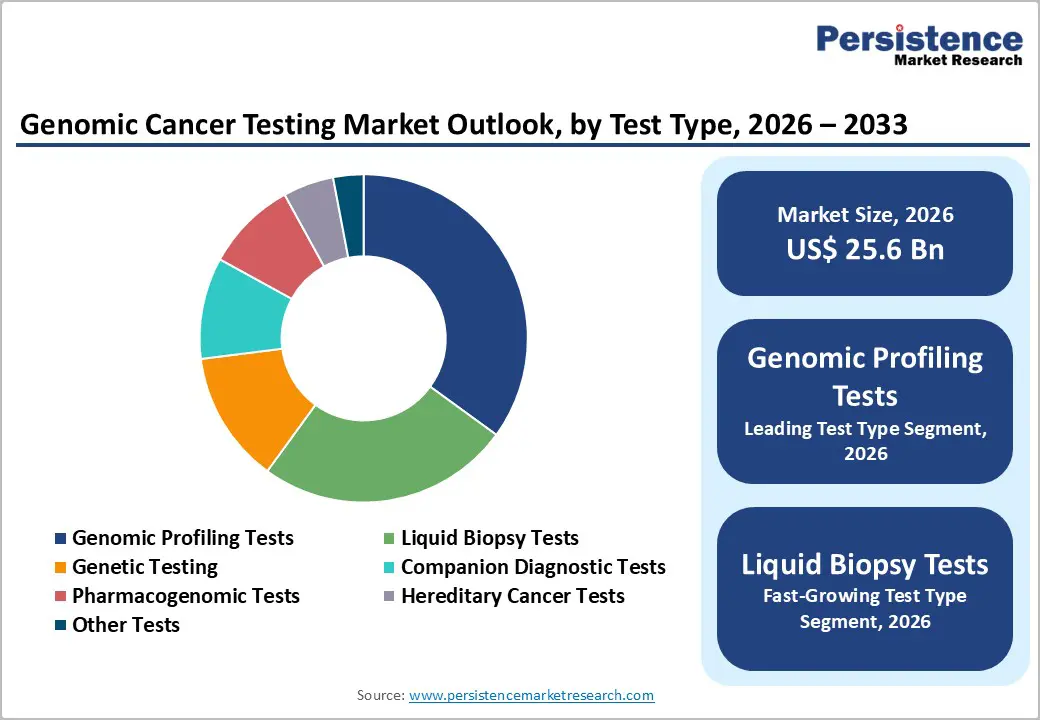
LONDON, UNITED KINGDOM, April 30, 2026 /EINPresswire.com/ -- The global genomic cancer testing market is poised for significant growth over the next decade. Expected to be valued at US$ 25.6 billion in 2026, the market is projected to reach US$ 75.9 billion by 2033, expanding at a compound annual growth rate (CAGR) of 16.8% from 2026 to 2033. This rapid growth is attributed to the aging population, rising cancer prevalence, and an increased demand for precise diagnostic solutions.
As cancer rates continue to climb, the need for personalized medicine and early detection technologies becomes more urgent. The adoption of advanced genomic tests, including next-generation sequencing (NGS) and liquid biopsy, supports high-throughput, accurate analyses, which are increasingly vital for effective cancer treatment. These technologies are enhancing oncologists' ability to select personalized therapies and predict patient outcomes with greater precision.
Download Your Free Sample & Explore Key Insights: https://www.persistencemarketresearch.com/samples/32721
Key Market Drivers
1. Aging Population and Rising Cancer Incidence
The rising number of cancer cases globally, particularly among aging populations, is a primary driver of the genomic cancer testing market. According to projections, over 2 million new cancer cases are expected in the U.S. by 2025. With cancer incidence sharply rising among older adults, the demand for accurate and early diagnostic solutions is expected to grow in parallel.
2. Technological Advancements and Innovations
The integration of cutting-edge technologies, such as NGS, liquid biopsies, and AI-assisted diagnostics, is transforming the genomic cancer testing landscape. NGS offers a comprehensive analysis of a patient’s genetic material, making it possible to detect genetic mutations and understand tumor behavior with exceptional accuracy. Similarly, liquid biopsy technologies, which detect circulating tumor DNA (ctDNA) from blood samples, provide a non-invasive method for early cancer detection and treatment monitoring.
Market Segmentation: Leading Test Types
Genomic Profiling Tests
In 2026, genomic profiling tests are expected to dominate the market, contributing over 35% of the market share. These tests allow for the identification of genetic mutations in tumor cells, helping clinicians choose the most effective targeted therapies. Comprehensive tumor analysis is essential in oncology, particularly for patients with complex cases who require advanced molecular characterizations. As these tests become increasingly integrated into electronic health records, their use in clinical settings is expected to grow.
Liquid Biopsy Tests
While genomic profiling will lead the market, liquid biopsy tests are forecasted to grow the fastest between 2026 and 2033. These tests are non-invasive, requiring only a blood sample to detect ctDNA. The technology is not only useful for diagnosing cancers early but also for monitoring therapy responses and detecting relapse. Liquid biopsies are becoming increasingly popular due to their ease of use and ability to detect genetic changes in tumors without needing tissue biopsies.
Regional Insights
North America
North America is anticipated to maintain its position as the market leader, accounting for an estimated 35% of the market share in 2026. The region benefits from strong healthcare infrastructure, cutting-edge research initiatives, and favorable reimbursement policies for precision oncology. The U.S. in particular has well-established genomic testing protocols, supported by large-scale federal programs like the National Institutes of Health (NIH).
Asia Pacific
The Asia Pacific region is expected to emerge as the fastest-growing market for genomic cancer testing between 2026 and 2033. Countries like China, India, Japan, and South Korea are investing heavily in expanding their healthcare infrastructure and integrating precision medicine into cancer care. The adoption of advanced diagnostic technologies, such as NGS and liquid biopsy, is accelerating, driven by both government policies and growing cancer incidences.
Get Custom Insights Designed for Your Businecss: https://www.persistencemarketresearch.com/request-customization/32721
Challenges to Market Growth
1. Lack of Standardized Testing Protocols
One of the primary barriers to broader adoption of genomic cancer testing is the lack of standardized testing guidelines across laboratories and regions. Variability in sequencing platforms, sample preparation, and result interpretation can lead to discrepancies in test outcomes. This lack of consistency poses challenges for clinicians when making treatment decisions and reduces confidence in genomic diagnostics.
2. Complex Data Interpretation
Another challenge is the complexity of genomic data interpretation. Genomic tests often produce vast amounts of data, including millions of genetic variants. Interpreting this data and translating it into clinically actionable insights requires highly skilled bioinformaticians and specialized knowledge. The scarcity of trained professionals in some regions, coupled with the need for powerful computational resources, slows the adoption of genomic testing in certain healthcare environments.
Market Segmentation
By Test Type
Genomic Profiling Tests
Genetic Testing
Liquid Biopsy Tests
Companion Diagnostic Tests
Pharmacogenomic Tests
Hereditary Cancer Tests
Other Tests
By Technology
Next Generation Sequencing (NGS)
Polymerase Chain Reaction (PCR)
Microarray
Fluorescence In Situ Hybridization (FISH)
Immunohistochemistry (IHC)
Others
By Application
Oncology Diagnostics
Prognostic Testing
Predictive Testing
Targeted Therapy Selection
Disease Monitoring
Risk Assessment
Drug Discovery & Development
By Region
North America
Europe
East Asia
South Asia & Oceania
Latin America
Middle East & Africa
Get Custom Insights Designed for Your Businecss: https://www.persistencemarketresearch.com/request-customization/32721
Competitive Landscape
The genomic cancer testing market is moderately consolidated, with key players such as Illumina, Thermo Fisher Scientific, Qiagen, and F. Hoffmann-La Roche commanding a significant portion of the market share. These companies leverage their expertise in advanced genomic technologies, collaborating with hospitals, research institutions, and healthcare providers to promote the adoption of cutting-edge diagnostics.
Future Outlook and Opportunities
The genomic cancer testing market is set for rapid expansion, driven by technological advancements, increased healthcare funding, and greater awareness of the benefits of personalized medicine. The development of companion diagnostics—which link specific therapies with diagnostic tests—promises to further streamline cancer treatment and improve patient outcomes. Moreover, the global expansion of genomic testing infrastructure, particularly in emerging markets, will increase the accessibility of these life-saving tools.
Read Related Reports:
Microdermabrasion Devices Market: The global microdermabrasion devices market is projected to grow from US$720.8 Mn in 2026 to US$1,329.5 Mn by 2033, driven by rising skin disorders.
Blockchain in Healthcare Market: The global blockchain healthcare market is projected to hit US$ 276.2 Bn by 2033, with at 42.5% CAGR, driven by rising data security and privacy needs.
Persistence Market Research
Persistence Market Research Pvt Ltd
+1 646-878-6329
email us here
Visit us on social media:
LinkedIn
Instagram
Facebook
YouTube
X
Legal Disclaimer:
EIN Presswire provides this news content "as is" without warranty of any kind. We do not accept any responsibility or liability for the accuracy, content, images, videos, licenses, completeness, legality, or reliability of the information contained in this article. If you have any complaints or copyright issues related to this article, kindly contact the author above.
